

Amazon | Bookshop.org | StoryGraph | Goodreads
This page contains affiliate links. If you click on the link and purchase a book, I may receive a commission of 4-10% at no extra cost to you. Thanks!
I unintentionally ended up doing a kind of deep dive into the transgender non-binary experience. This happens often. When my brain is spinning on a topic, I consume as much information as possible. In this case, I was simultaneously reading the memoirs None of the Above by Travis Alabanza and Cactus Country by Zoë Bossiere and Reclaimed by Seth Haddon, a spicy fantasy with a trans non-binary main character.
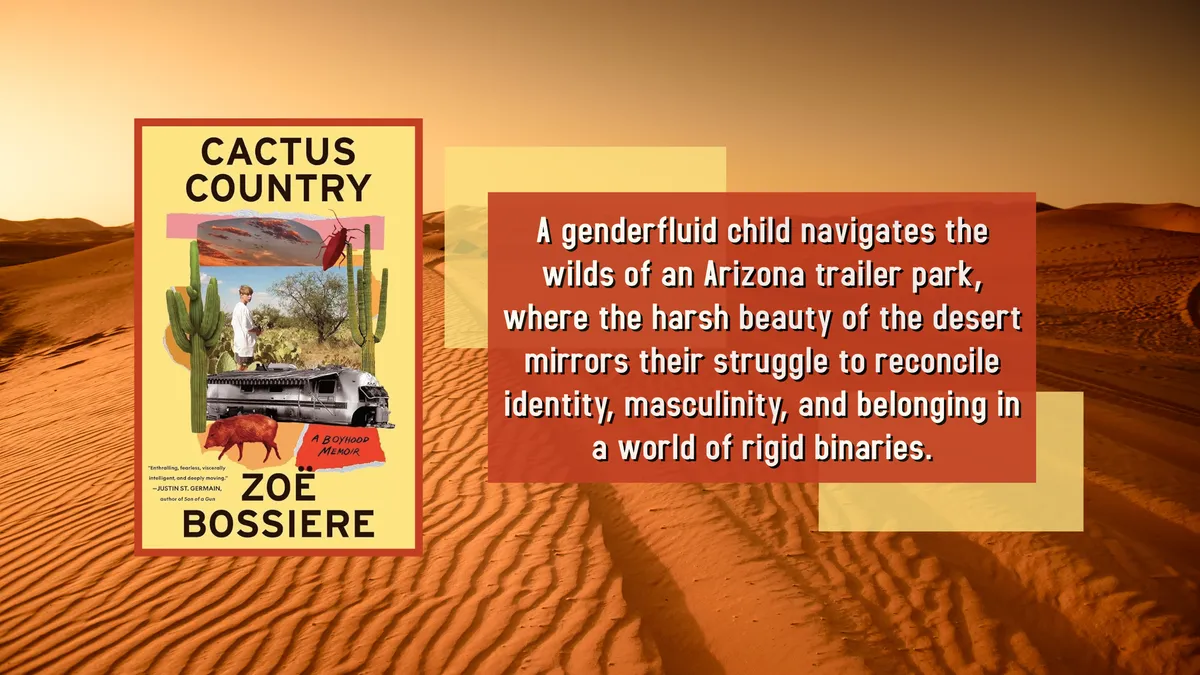
I recommend all three books, but for this post, we're talking specifically about the memoir Cactus Country by Zoë Bossiere. We follow Bossiere as he grows up in an RV park near Tucson Arizona, called Cactus Country. As a child, he lives as a boy, playing with the other boys who cycle through the RV park. Masculinity in the harsh desert environment dictates how people assigned male at birth (AMAB) interact with the world and each other. Both unifying and stifling. As a boy, he winds his way through this unknown country, desperate to belong while always asking why. As they get older and puberty hits, kids become crueler about Bossiere's androgynous expression and refusal to name their gender assigned at birth.
As a teenager and later in college, Bossiere can't escape the experience of many femme-presenting cis-women who aren't equally respected in mixed company and who are routinely referred to as bitches or sluts. No matter how much Bossiere tries to fit in with the guys, the guys treat them like they treat the women in their lives.
We watch as Bossiere tries to find a place for themself within the queer community, which doesn't always hold space for transgender non-binary people, especially a decade or two in the past. They struggle to ferret out a label that encompasses their complicated and often fraught relationship with their body and how society only regards external gender expression as real and therefore valid.
Bossiere's story is not a series of vignettes meant to tidily string together traumatic and joyous events into a compelling story. They show us their life in startling detail from childhood to college. I'm reading for the emotional journey, but I also feel the grit beneath his bare feet as he climbs Palo Verde trees, I see the coffee cup their dad throws at them during a fight, and the dog they try to hide in the desert so he doesn’t have to give him up. Bossiere plants us firmly in their shoes. We don't zoom out for a big-picture view or even a look back through the eyes of an older, wiser Bossiere until the end of the story. It was easy for me to forget that I was reading a memoir and not literary fiction because of the close, personal narrative of Bossiere's storytelling.
This is a conversation about the cage of gender, societally and internally. The entrenchment of gender in the public psyche as a hierarchical social imperative leads to the self-policing and community policing of other people's gender expression when it falls outside what is expected. Both Cactus Country and None of the Above address the knee-jerk rage cisgender people experience when those expectations aren't met. However, this is more directly elucidated in None of the Above.

In Cactus Country, we read one person's personal journey with gender until the book's present day. As people change, so does their relationship with their body and mind. I suspect readers will identify with Bossiere‘s childhood grievances with gender and its strictures more than they'll want to admit. We all have grievances with gender expectations and instead of asking ourselves how gender serves us, we entrench ourselves deeper by pointing the blame in every direction, dragging men and women at every opportunity and scoffing at anyone who doesn’t want to play this age old game. It’s exhausting, more so if you’re having to field invasive questions from complete strangers about your genitals when you’re just trying to live your life.
"Gradually, I stopped binding my chest and correcting people on my pronouns. I stopped caring how others perceived my gender or didn't. What happened to me next, or didn't. Mostly I wanted to disappear, for the person inside my body to become no one and my gender to become nothing."
Personally, I related hard to the above quote. Gender expectations, one among many expectations, leave me lethargic and apathetic. I want to exist without perception, because I am stuffed roughly into a box the moment I am perceived. I know my gender informs how people treat me. I know in the hierarchy of bias; I am below white men, but I'm above everyone else. That knowledge makes me want to opt out entirely. I can't just be; I must perform.
This is for people who like memoirs in the vein of In The Dream House by Carmen Maria Machado. If you like immersive narrative memoirs or want to read about someone else's lived experience, then this is the book for you. The audiobook was also very good.

/rae/